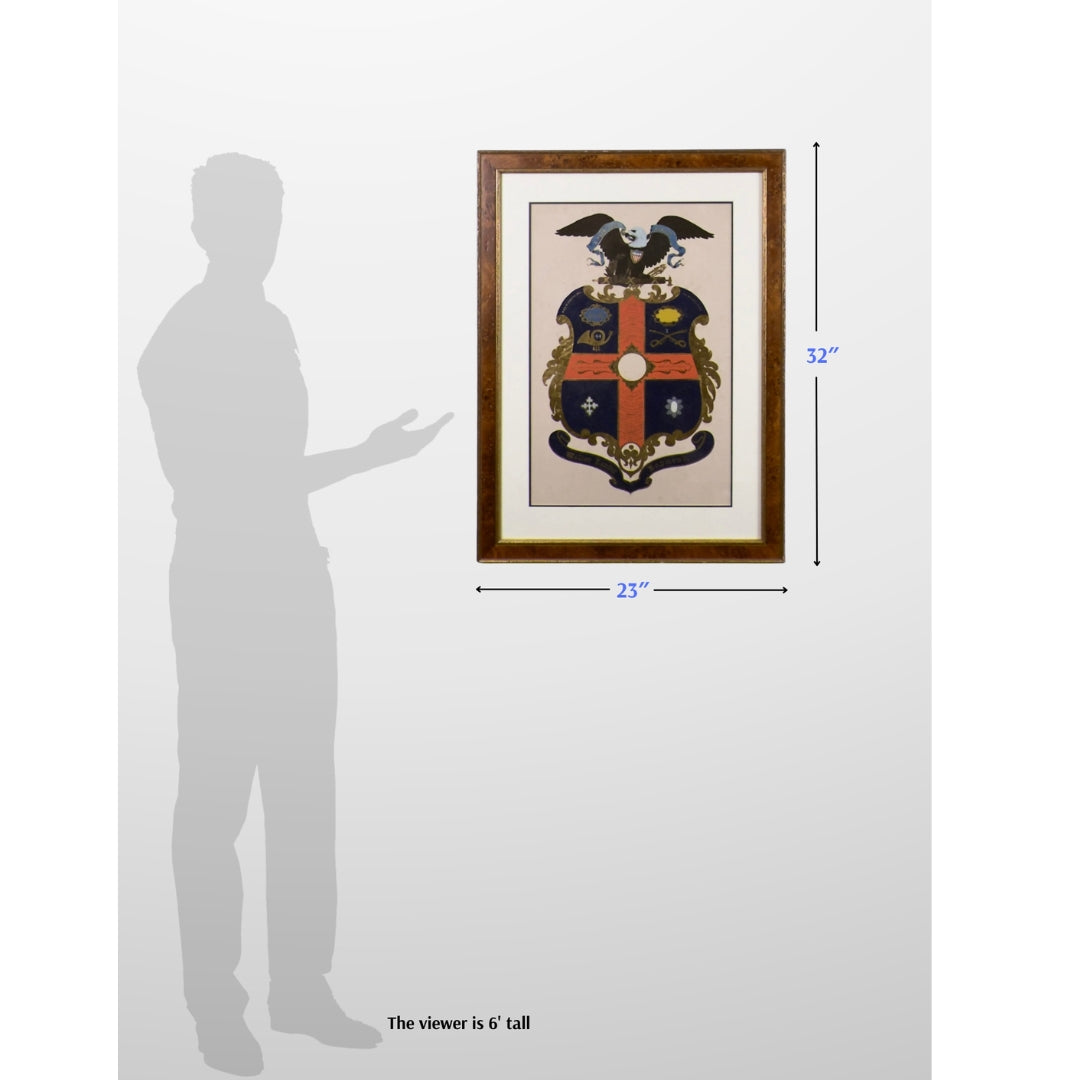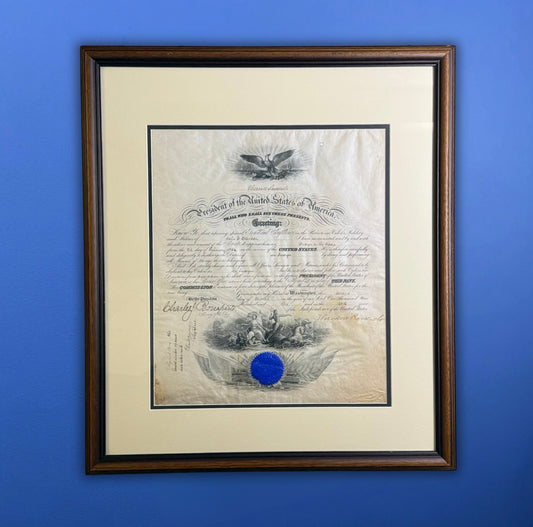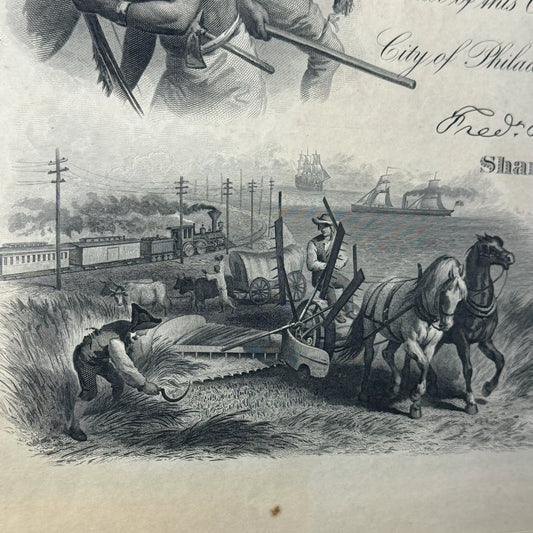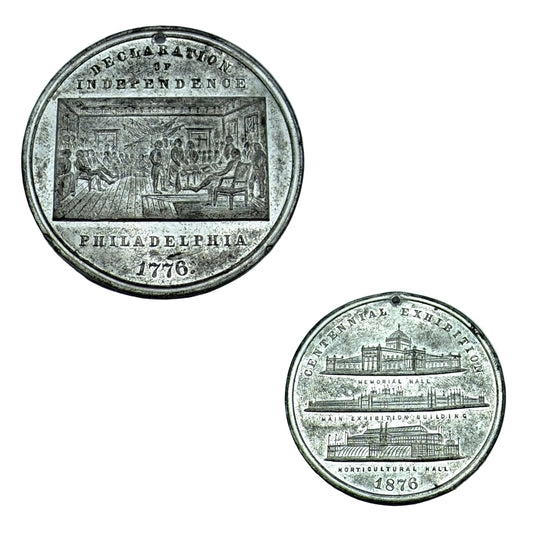


Civil War Escutcheon — Framed — Walton Landor Raymond — 44th Massachusetts Volunteer Militia and the 1st Mass. Cav.
Civil War Escutcheon — Framed — Walton Landor Raymond — 44th Massachusetts Volunteer Militia and the 1st Mass. Cav.
Updated March 26, 2026: This has been sold.
This hand-painted escutcheon shows the service record of Private Walton Landor Raymond of the 44th Massachusetts Volunteer Militia and the 1st Mass. Cav.
This escutcheon is in excellent condition, with bright colors.
Raymond enlisted as a Private in 1862 and re-listed into the Cavalry in 1864. He was captured at Charles City and confined in Libby Prison and then sent to Salisbury, North Carolina where he died on Christmas 1864, "buried in the trenches."
While Libby Prison may be familiar, Salisbury may not be. See below for more historical background.
Size of frame: 23" x 32"
Shipping: $35. Please allow two weeks for shipping.
Historical background on Salisbury Prison
It was the first and only Civil War prison in North Carolina.
From the Encyclopedia of North Carolina:
" . . . in early October 1864, when 10,000 prisoners began arriving at a facility that was intended to hold only 2,500. This huge increase, which resulted from the fall of Atlanta and the ongoing siege of Richmond, made it easier for the Union army to rescue its POWs. Salisbury received some of the Richmond prisoners, and after October 1864, the majority of newly captured Union POWs.
"The most painful period for the Salisbury prisoners was from October 1864 until their release in February 1865. Accounts from POW diaries indicate that the prisoners took in about 1,600 calories per day, whereas 2,000 calories was considered the minimum for survival under the adverse conditions that existed at Salisbury. It is not surprising that diarrhea was the most common disease as well as the most deadly, due in large part to the overcrowding and unsanitary conditions.
"From December 1861, when it opened, through September 1864, Salisbury Prison experienced a 2 percent death rate (about 100 deaths). But between October 1864 and 15 February 1865, the rate soared to 28 percent. An estimated 4,000 prisoners died at the prison during its existence, for an overall death rate of 26 percent. Bodies were collected daily at the "dead house" and hauled in a one-horse wagon to trenches in a nearby "old cornfield." A visitor to the cemetery today finds these 18 trenches to be the most somber, painful, and shocking part of the Salisbury National Cemetery. The total death rate in Union and Confederate prisons is considered to have been about the same at 12 percent.
"In the fall of 1864 escape from Salisbury Prison was considered almost necessary to save one's life. Many POWs escaped, but only about 300 reached Union lines. During an attempted mass escape on 25 Nov. 1864, none got away and about 200 prisoners lost their lives. Tunneling became popular with the POWs. The most famous tunnel escape took place in mid-January 1865, when an estimated 100 managed to flee the prison. According to one prisoner, the easiest way to get "out of this cursed place" was to defect to the Confederacy. Although about 2,100 POWs reportedly defected, these soldiers contributed little to the Confederate cause."
Made by America
Made by America
Almost all of the new products we offer are designed by us and made in America and most of our Rare Finds were made in America.
Our original designs are based on our nation’s history and our love of American history. Read more about other things we've created, including The History List, History Camp, and The Pursuit of History, in addition to The History List Store.
Every product that is made in America states that in the product description and includes the "Made in U.S.A." graphic.