

"The Adams Papers" — The Earliest Diary of John Adams — From June 1753 to August 1777 — Five volumes
"The Adams Papers" — The Earliest Diary of John Adams — From June 1753 to August 1777 — Five volumes
Couldn't load pickup availability
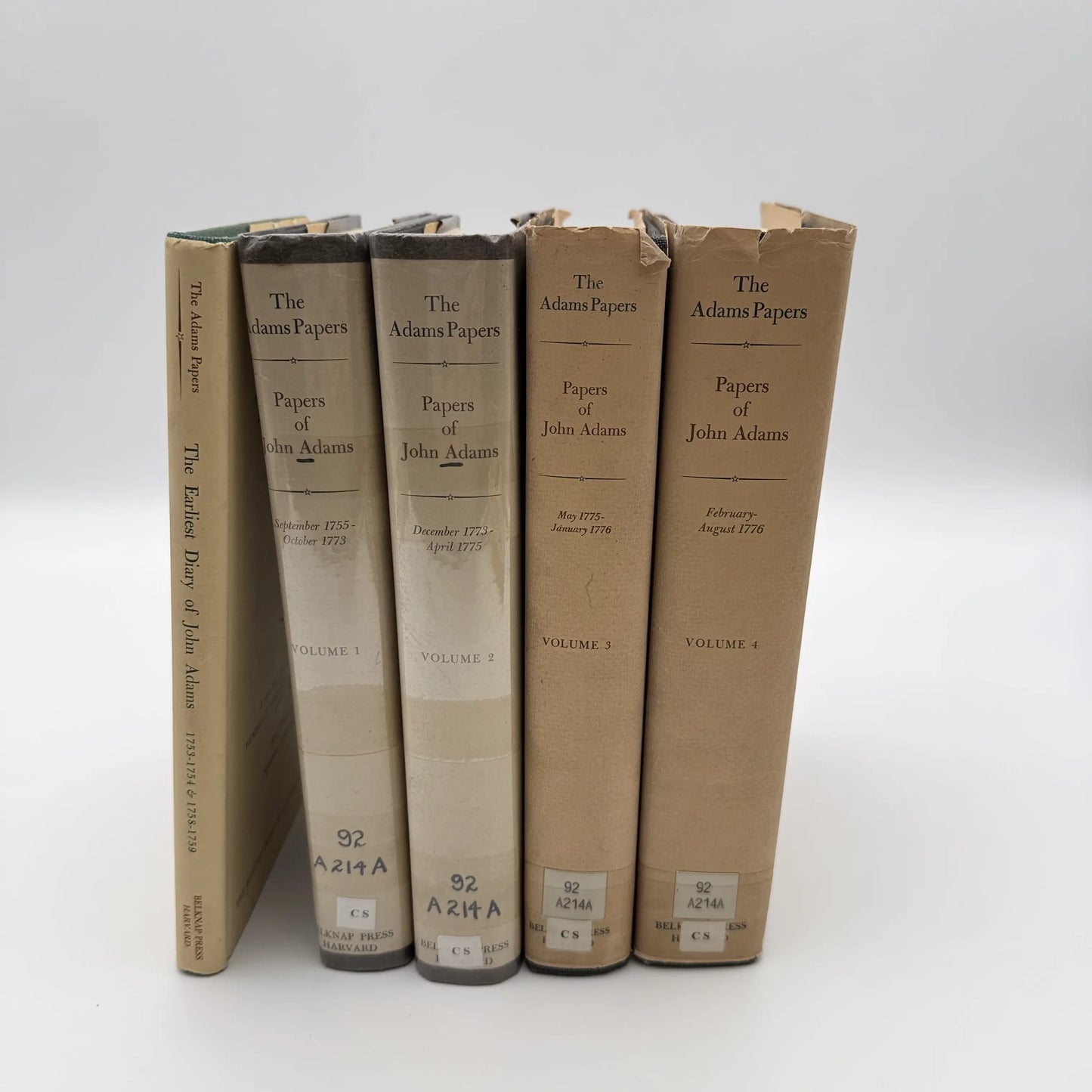
A collection of the diary and autobiography of John Adams, plus general correspondence and other papers. In five volumes.
Published by The Belknap Press of Harvard University Press.
Volumes available:
-
SOLD — The Earliest Diary of John Adams — June 1753 - April 1754 and September 1758 - January 1759
From the publisher:
"The existence of this diary was totally unsuspected until its recent and somewhat accidental discovery among papers at the Vermont Historical Society during a search by Wendell D. Garrett, Associate Editor of the Adams Papers, for Adams family letters of a later period.
In part, the diary antedates by more than two years all other diaries of John Adams, and as a whole it is an invaluable addition to the Adams Papers, significantly supplementing the Diary and Autobiography of John Adams issued by the Belknap Press in four volumes in 1961. The editors’ introduction describes the romantic and dramatic circumstances under which the diary is believed to have left the hands of the Adams family and found its way into the possession of young Royall Tyler, later a successful writer and distinguished Vermont judge, but in the 1780s a suitor for the hand of John Adams’s daughter Abigail. Among other matters, the newly found diary contains material on John Adams’s life as an undergraduate at Harvard, his choice of a career, his law studies and his first case as a practicing lawyer, his ambitions, and his observations on girls.
As L. H. Butterfield, editor in chief of the Adams Papers, says of John Adams, “He almost never fails to give even his casual reflections a characteristic turn. He is a great stylist… His wry, amusing, engaging comments, whether on daily life in New England, on literature, science, or government, show an original mind at work.”
142 pages, 13 halftones -
Volume 1 — September 1755 - October 1773 and Volume 2 — December 1773 - April 1775 — Adams Family Correspondence
From the publisher:
"Volumes one and two of the Papers of John Adams include letters to and from friends and colleagues, reports of committees on which he served, his polemical writings, published and unpublished, and state papers to which he made a contribution. All of Adams’s newspaper writings, including “A Dissertation on the Canon and the Feudal Law,” are in these two volumes. In addition to being a condemnation of the Stamp Act, the “Dissertation” is shown to be one of the building blocks of the theory of a commonwealth of independent states under the king, which reaches complete statement in the Novanglus letters. For the first time, all 13 of these letters appear in full with annotation.
"The period September 1755-April 1775 covers Adams’s public service in Braintree and Boston town meetings, the Massachusetts House of Representatives, the First Continental Congress, and the First Provincial Congress of Massachusetts. During this time his political future was being shaped by circumstances not always of his choosing. He hesitated at first at the threshold of a public career, political ambition in conflict with concern for his family’s well-being. But as the confrontation with Great Britain sharpened, the crisis became acute; no choice remained. For Adams there was no shirking the path of duty."
-
Volume 3 — May 1775 - January 1776 and Volume 4 February - August 1776
From the publisher:
"As the American colonies grew more restive, and a break with the mother country ceased to be unthinkable, John Adams was forced to spend less and less time with his beloved family. Although burdened by ever-expanding responsibilities in the Second Continental Congress, he found time for an amazing amount of correspondence.
"The majority of his letters were written to secure the facts that would enable this duty-ridden man to decide and act effectively on the issues being debated. Military affairs, a source of never-ending concern, provide some of the most fascinating subjects, including several accounts of the Battle of Bunker Hill, assessments of various high-ranking officers, and complaints about the behavior of the riflemen sent from three states to the southward to aid the Massachusetts troops. The heated question of pay for soldiers and officers early strained relations between New England and southern colonies. By refusing to confront the issue of slavery when it was raised by several correspondents, Adams sought to avoid exacerbating regional sensitivities further.
"When the question of independent governments for former colonies arose, at the request of several colleagues Adams sketched a model: Thoughts on Government, three versions of which are included here. His optimistic republicanism, however, was balanced by fear that a “Spirit of Commerce” would undermine the virtue requisite for republican institutions.
"Adams’s important committee work included his draft in 1775 of rules for regulation of the Continental Navy, which have remained the basis for the governance of the United States Navy down into our time, and his plan of treaties, which would guide American diplomatists up to World War II. Both were derivative, but he skillfully adapted his materials to American needs and circumstances.
"These volumes reflect the spirit of those tumultuous years when the leaders emerging in America confronted each other, and exciting new ideas, as they tried to resolve the issues of a revolutionary period."
Shipping: $15. Please allow two weeks for shipping.
Made by America
Made by America
Almost all of the new products we offer are designed by us and made in America and most of our Rare Finds were made in America.
Our original designs are based on our nation’s history and our love of American history. Read more about other things we've created, including The History List, History Camp, and The Pursuit of History, in addition to The History List Store.
Every product that is made in America states that in the product description and includes the "Made in U.S.A." graphic.